
Frederick University is a private university operating in the Republic of Cyprus, a member state of the European Union. It began its operation in September 2007 following a decision of the Council of Ministers of the Republic of Cyprus and following the successful, long-standing course of the Frederick Institute of Technology in education and research. In January 2012, the University received its final operating license following a decision of the Council of Ministers.
The mission of Frederick University is to provide learning opportunities through teaching and research in the fields of science, technology, letters and arts, as well as the general contribution to society as a whole. The education offered by Frederick University is of a high quality and leads to recognized qualifications, which ensure its graduates a scientific and professional career, mobility and competitiveness, in Cyprus and abroad. At Frederick University, interdisciplinary knowledge exchange is cultivated, transmitted and implemented.
Frederick University operates five Schools covering almost the entire spectrum of education and offering programs at undergraduate, postgraduate and doctoral levels. It is headquartered in Nicosia, the capital of the Republic of Cyprus, while specific Schools and Departments also operate at the University’s branch in Limassol. The official languages of the University are Greek and English.
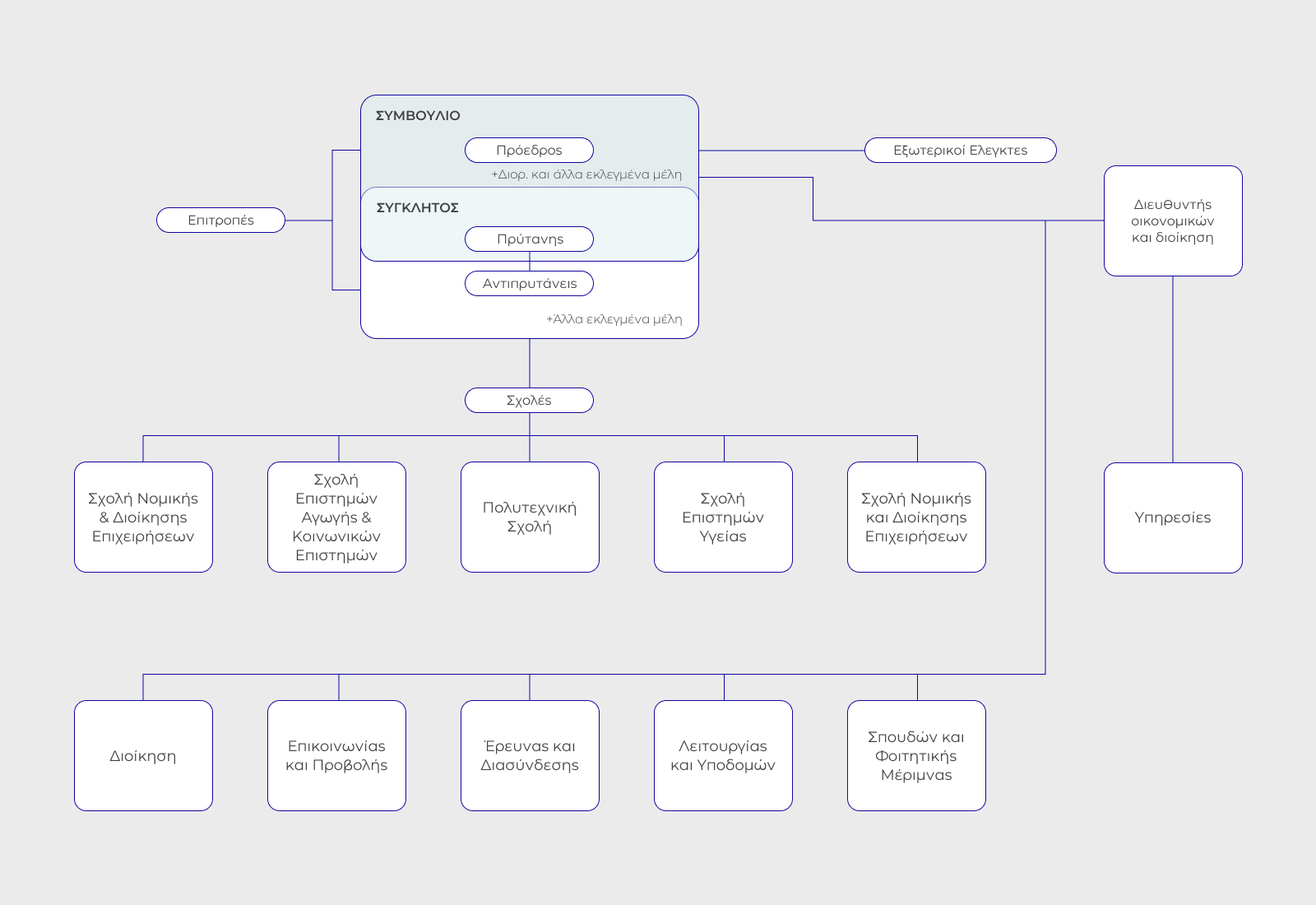
Frederick University follows international practices in relation to its organization and administration. The highest administrative body of the University is the Council, which is responsible for the administration of all non-academic matters.
The highest academic body of the University is the Senate. The Senate is responsible for the academic functions of the University, namely teaching, curricula, the promotion of scientific research and any other academic activity. The Senate is headed by the Rector, who is elected by all members of the academic staff of the University. All bodies of the University also include student representatives elected by the student community.
The University is academically organized into five Faculties:
The Faculties are organized into Departments and in total there are 14 Departments operating at the University. The Departments are responsible for offering the various study programs of the University while inter-departmental and inter-school programs are also offered.
The Departments are staffed by members of the University’s academic staff. The academic staff consists of scientists who have distinguished themselves in Universities in Greece, Europe, the USA and other countries with many years of teaching experience and extensive research work.
Frederick University operates under the relevant law on private universities of the Republic of Cyprus. Its study programs are evaluated and approved by a special committee, the Private Universities Evaluation Committee (PUK), appointed by the Government. This Committee also has the general supervision of the operation of the University.
In January 2012, the University received its final operating license following a decision of the Council of Ministers. The decision was made on the basis of the report of the Private Universities Evaluation Committee, which records the course of development and progress of the University from October 2007 to October 2011, a period during which the University operated under an initial operating license.
All the University’s programs are fully recognized by the Republic of Cyprus and by all countries of the European Union. Frederick University has been offering doctoral programs since the 2010-2011 academic year. The doctoral degree is the highest degree a university can award, and Frederick University is particularly pleased with this achievement.
Recognition by DOATAP
Frederick University, after submitting an application and undergoing a thorough evaluation, was recognized by the Interdisciplinary Organization for the Recognition of Academic and Information Titles (DOATAP) of Greece as an Affiliated Institution of Greek Higher Education Institutions, and its Schools and Departments as equivalent to those of Greek HEIs.
Recognition by professional bodies
The study programs also enjoy the corresponding professional recognition by the professional bodies below. Recognition by professional bodies is of paramount importance for graduates since in many cases it is a prerequisite for the right to practice a profession.
Cyprus Scientific and Technical Chamber (CSC)
The Cyprus Scientific and Technical Chamber (CSC) has recognized all Frederick University programs that fall within its competence, resulting in graduates being registered with the Chamber.
European Council of Architects
The five-year Diploma in Architecture is officially recognized by the European Council of Architects, based on the relevant European Union directive (Article21(7) of Directive 2005/36/EC Qualifications of Architects).
Cyprus Nursing and Midwifery Council
The Nursing Program has been certified by the Cyprus Nursing and Midwifery Council and graduates are registered in the Cyprus Nursing Register.
European Commission – Degree in General Nursing
The Degree in General Nursing is officially recognized by the European Commission, as is the professional title of Nurse in General Nursing based on the relevant European Union directive (Annex V, point 5.2.2 of Directive 2005/36/EC)
Register of Social Workers of Cyprus
Graduates of the Social Work program are registered in the Register of Social Workers of Cyprus.
Education Service Committee of the Ministry of Education and Culture
Graduates of the Primary Education and Pre-Primary Education programs are registered in the lists of the Education Service Committee of the Ministry of Education.
Association of International Accountants (AIA)
Graduates from the Accounting & Finance and Business Administration programs are exempt from 12 of the 16 AIA papers.
Association of Chartered Certified Accountants (ACCA)
Graduates from the Accounting & Finance and Business Administration programs are exempt from 9 and 8 of the 14 ACCA papers respectively. Graduates from the Maritime Studies program are also exempt from a number of ACCA exams.
Institute of Chartered Accountants of England and Wales (ICAEW)
Graduates from the Accounting & Finance program are exempt from 8 of the 15 ICAEW papers.
Institute of Chartered Shipbrokers
Graduates of the Maritime Studies programme are exempt from a number of ICS examinations.
Award of ECTS Label and Diploma Supplement Label
During the 2011-2012 academic year, Frederick University was awarded the ECTS Label, the highest mark of recognition by the European Commission for the excellent implementation of the European Credit Transfer and Accumulation System (ECTS). Frederick University is among 23 other universities across Europe to receive the ECTS Label this year. ECTS is a student-centred system for the accumulation and transfer of credits, based on the transparency of learning outcomes and learning processes. It aims to facilitate the planning, delivery, assessment, recognition and validation of qualifications and learning modules, as well as student mobility.
This recognition follows the success of the previous year, when Frederick University was awarded the Diploma Supplement Label by the European Commission, in recognition of the University’s excellent work in implementing the Diploma Supplement. The Diploma Supplement is an explanatory document attached to a degree awarded by a higher education institution, which provides transparency and facilitates the academic and professional recognition of qualifications, as well as student mobility.
Both of these recognitions give Frederick University a prominent position among other European universities and establish it as a most reliable partner in European and international cooperation.
Through its continuous pursuit of providing quality education, Frederick University ensures that it has the appropriate facilities to support the various study programs it offers. The University operates in two cities, Nicosia and Limassol. Every year, the University invests several million in the development of its building infrastructure to meet the ever-increasing needs.
It is worth noting that since its inception, the University has almost doubled the area of its building facilities, which include the new building of the Department of Architecture, the purchase and rental of buildings for the office needs of teaching staff and doctoral students and scientists, the construction of the new state-of-the-art Engineering laboratory, and the creation of other spaces to support educational needs. In addition, permission has already been granted to expand the Limassol Branch building with an additional floor to meet the needs for laboratories and seminar rooms.
| Building | Function | Address | |
| Office of the University President, administrative offices, lecture halls, computer laboratories, School of Health Sciences laboratories, studio, gymnasium | 7 Frederickou St., Pallouriotissa, 1036, Nicosia | |
| New Wing | Rectorate, Human Resources offices, seminar rooms, student cafeteria | 7 Frederickou St., Pallouriotissa, 1036, Nicosia | |
| Library Building | Library, Human Resources offices, meeting rooms, restaurant | 7–9 Filokyprou St., Kaimakli, 1036, Nicosia | |
| Demokritou Building | Research laboratories, staff offices, administrative services | 23 Demokritou St., Pallouriotissa, 1036, Nicosia | |
| Department of Architecture Building | Classrooms, laboratories, studio, offices of the Department of Architecture | 13 Dimitriou Chamatsou St., Pallouriotissa, 1040, Nicosia | |
| Engineering Laboratories | Research and teaching laboratories of the School of Engineering and Applied Sciences | Agiou Dimitriou St., Kaimakli, 1027, Nicosia | |
| CYTA Building | Offices for staff and doctoral students | Kyriakou Matsi St., Pallouriotissa, 1035, Nicosia | |
| Limassol Building | Administrative and academic staff offices, lecture halls, computer laboratories, research and teaching laboratories, studio, cafeteria serving the needs of the Limassol Campus | 18 Mariou Agathangelou St., Agios Georgios Chavouzas, 3080, Limassol |
One of the main pillars of Frederick University’s activities is the development and transfer of knowledge through basic and applied research activities. Therefore, the University aims to continuously improve its position as a research institution of international prestige, with a significant contribution to science, technology and innovation, for the benefit of local and European society and economy.
The academic staff of the University, whether organized in interdisciplinary teams or individually, participate in a wide range of research activities intertwined with their scientific fields of specialization. More specifically, the main areas of activity of the University’s research groups are the following:
Research Programs and Network of Collaborations
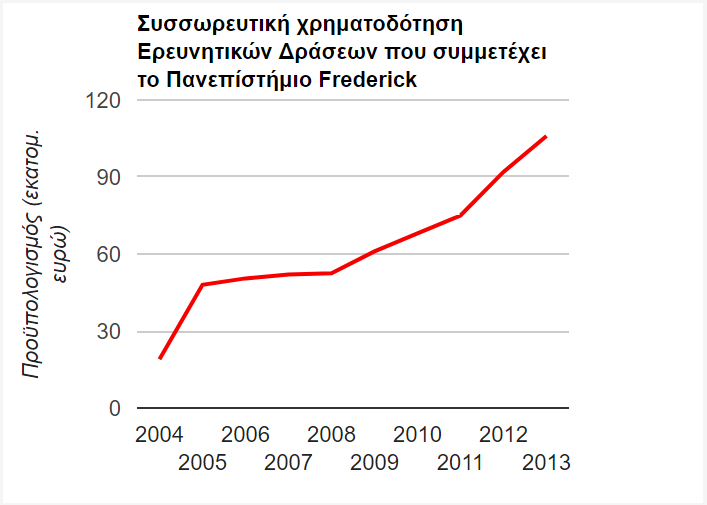
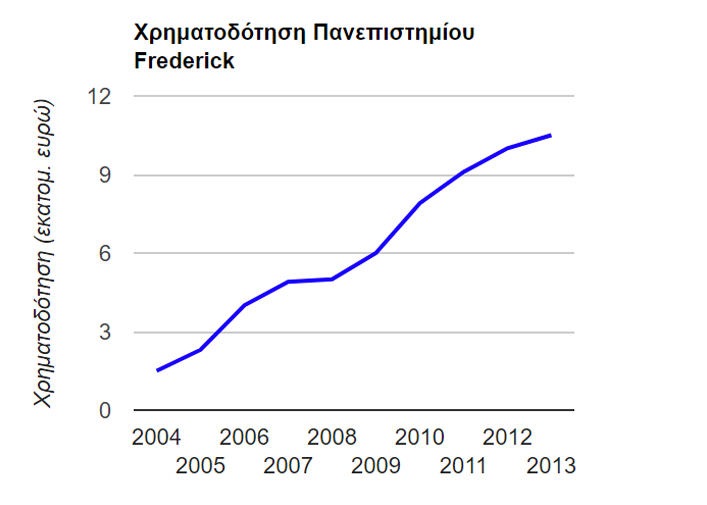
Frederick University is one of the main research organizations in Cyprus. In the last 10 years, Frederick has participated in more than 110 research programs. The selection of these programs was made through competitive procedures and received funding from bodies such as the European Union, the United Nations, the Research Promotion Foundation, etc. The total funding for these programs exceeds 80 million euros, while Frederick University’s participation budget exceeds 9 million euros. In addition to research programs, University staff can participate in advisory committees or provide consulting services, thus promoting the dissemination of knowledge.
To support these research activities, the University has developed a rich and multidimensional network of partnerships that aims to promote scientific research and the transfer of knowledge to society and the economy. The University maintains partnerships with over 70 universities in countries such as the United Kingdom, Germany, Greece, the United States, China, and others. It has also collaborated with over 100 organizations, including non-governmental organizations, small and medium-sized enterprises, and multinationals.
Academic Staff
A necessary condition for the achievement of the goals and mission of the University, as a modern educational and research institution, is its staffing with highly qualified academic staff. For this reason, Frederick University has established high quality evaluation criteria and strict procedures for the recruitment or promotion of academic staff members. The criteria and procedures applied by Frederick University are consistent with those provided by the applicable legislation and are applied to public universities in Cyprus and are generally the same as those applied to foreign universities with international recognition.
At the same time, Frederick University, with the provisions of its Charter, ensures academic freedoms in education and research and provides financial and other benefits to academic staff of the same scale as those provided by public universities in Cyprus. With the above measures, Frederick University seeks to attract high-quality academic staff to meet its educational and research needs.
At the University, the educational staff is classified into the following categories:
Χρησιμοποιούμε cookies για να σας προσφέρουμε την καλύτερη δυνατή εμπειρία στη σελίδα μας.